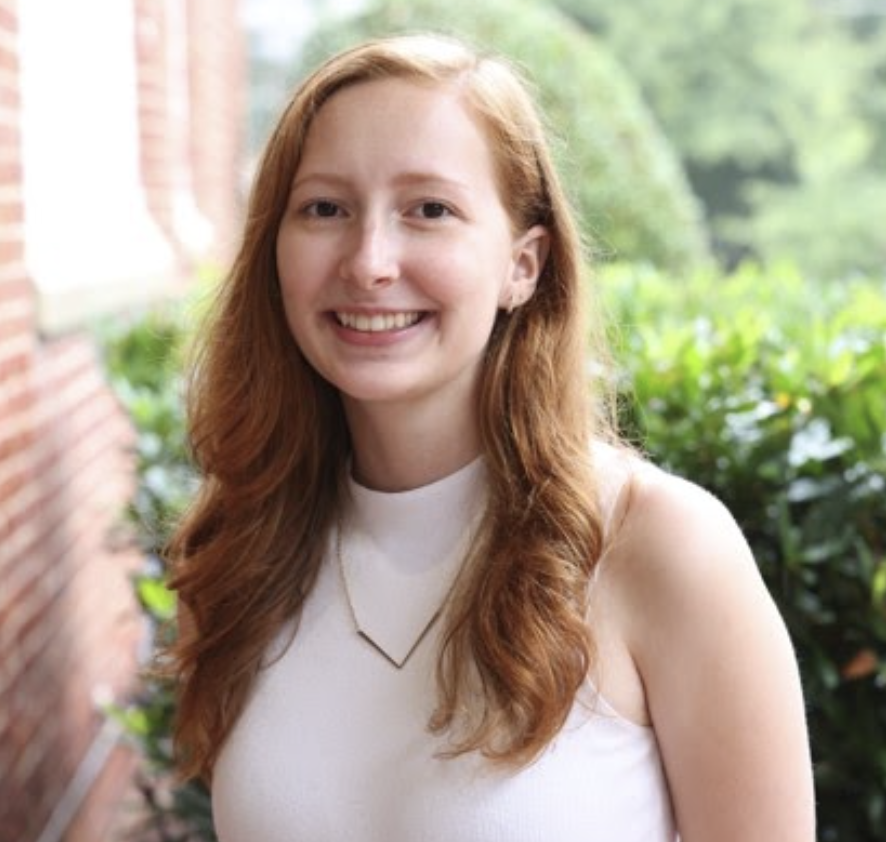
The Healthy Regions Lab is thrilled to bring on Dr. Hilary Fath (Sandborn) as the new Postdoctoral Research Scientist supporting the Localize Opioid Use Disorder (LOUD) Study, and the SDOH & Place Project. Hilary joins us from University of North Carolina at Chapin-Hill, where she completed her PhD under the supervision Dr. Paul Delameter at the North Carolina Population Center. The team looks forward to collaborations that bring her health geography chops and geocomputational expertise.
What is your background, & what brought you to health geography?
Growing up, I was involved in several humanitarian aid and service trips through organizations I was involved with. Those experiences sparked my interest in geography by helping me see that where people live can shape their vulnerability, access to resources, and health outcomes. A love of travel and maps further confirmed my choice of discipline. These interests led me to pursue a B.S. in Geographic Information Science (GIS) and Anthropology from the University of Maryland, followed by an M.A. and Ph.D. in Health Geography from the University of North Carolina at Chapel Hill.
What was your doctoral research about?
My dissertation, “Advancing Agent-Based Modeling for Healthcare System Planning During the COVID-19 Pandemic” examined how computational models represent people and healthcare systems during infectious disease outbreaks, using COVID-19 in North Carolina as a case study. I focused on improving synthetic population data, adding more realistic health risk factors, and comparing different ways of assigning patients to hospitals. This works highlights which modeling choices matter, how they matter, and why they are consequential for health system planning and response.
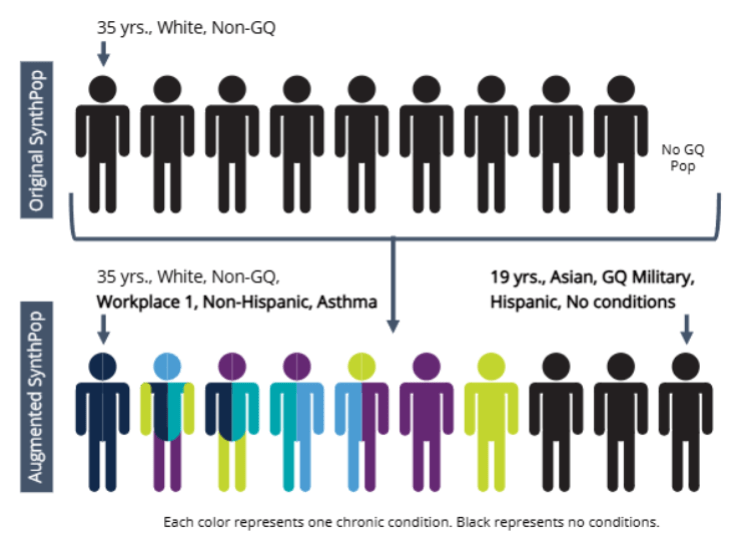
From Aim 1 of my dissertation, this figure (above) visualizes how I augmented an already existing synthetic population dataset (SynthPop) by adding more realistic social and health characteristics. The top panel represents the original synthetic population dataset that has limited demographic detail, while the bottom panel represents the augmented version with added information such as group quarters (GQ) populations, workplace assignments, ethnicity, and chronic condition information.

From Aim 3 of my dissertation, the above figure compares two ways of assigning synthetic individuals to hospitals: a distance-based approach (left) and a utilization-based approach (right). The maps show how the choice of assignment method changes how hospital burden is distributed across space, with the circles representing individual hospitals and the size of the circles representing how often hospitals were full (top) or occupied (bottom) during the study period. This modeling choice can affect how healthcare system strain is represented and thus, how pandemic planning decisions are made.
What is one goal you hope to achieve in your first few months at HEROP?
As a Postdoctoral Research Scientist in the HEROP Lab, I hope to bring new tools and methods to the team. The lab already does amazing work with documentation, visualization, and making their work accessible to the public, and I’d love to build on this by showing how tools like synthetic populations and agent-based models can be used to expand this work in new directions. In my first few months, my goal is to get familiar with the existing tools and datasets and contribute feedback from a fresh perspective.
What is your favorite way to spend a weekend?
Outside of work, my ideal Saturday would be sleeping in (just a little bit!), going to the farmer’s market to get the best sweet potato donuts, then exploring the town’s local books, gift, and craft stores. This would be followed by a chill afternoon at home and then hanging out with friends for dinner and game night. Finally, it would be topped off by coming home and reading a few chapters of a good book before bed.

This picture with my husband was taken on a camping trip to the New River Gorge in West Virginia.

This picture was taken at the top of Grandfather Mountain in Boone, NC.
The team looks forward to working with you, Hilary!


Leave a Reply