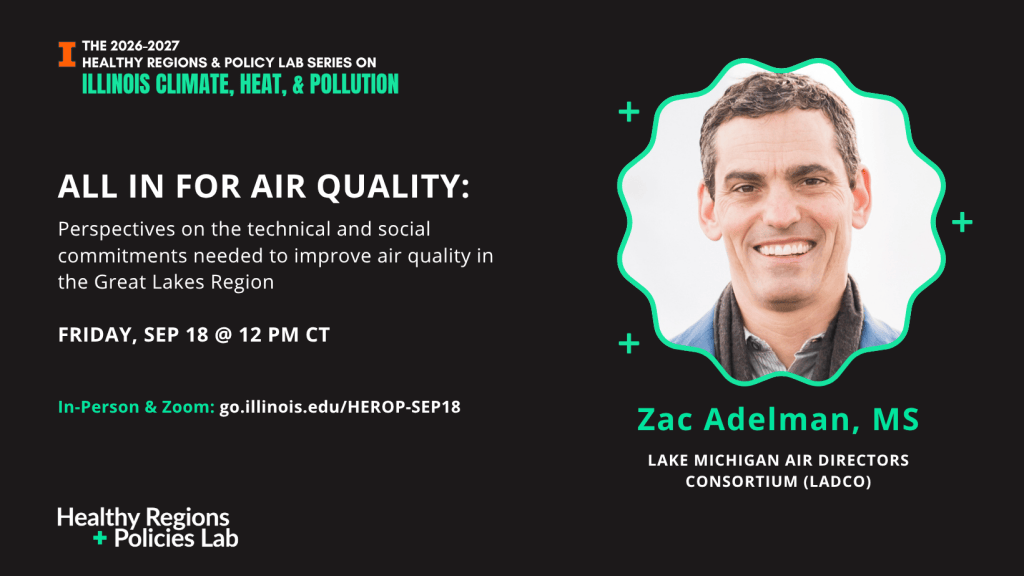
Join us for lunch, learning, and conversation at the next installment of the HEROP Speaker Series on Friday, Sep. 18th, at 12 PM CT. Coffee and networking session to follow. For folks outside of the UIUC community, please join us via Zoom!
All In For Air Quality: Perspectives on the technical and social commitments needed to improve air quality in the Great Lakes Region
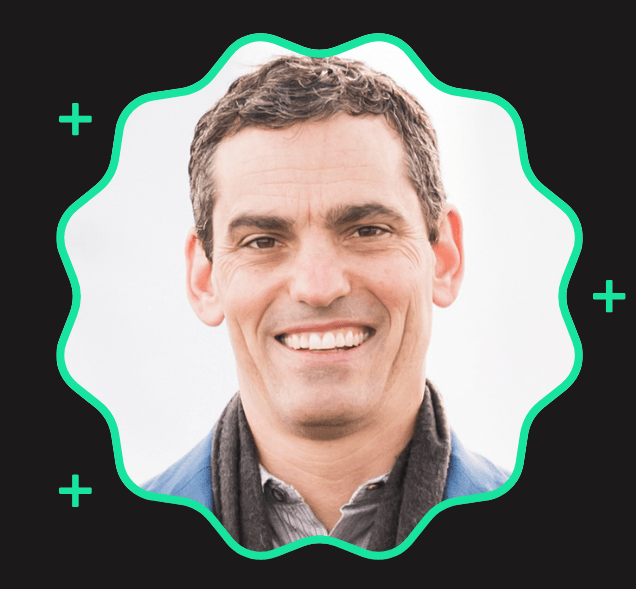
Zac Adelman, MS
Lake Michigan Air Directors Consortium (LADCO)
Friday, Sep 18th @ Noon,
via Zoom & In-Person at NHB 2049 in Urbana, IL
The Great Lakes region has spent more than three decades cutting air pollution, and for the first time, attainment of the 2015 ozone health standard around Lake Michigan looks achievable. But two recent summers of Canadian wildfire smoke, in 2023, 2025, and 2026 are a preview of a less controllable future, and getting the rest of the way to clean air will take more than better models and emissions inventories.
Drawing on the Lake Michigan Air Directors Consortium’s (LADCO) technical work for its six member states, Mr. Adelman will translate what current ozone and particulate matter trends tell us about who breathes the worst air in the region, and why. The pattern is not uniform: broad progress across most of the basin, a stubborn ozone problem concentrated in the shoreline communities of Chicago, Milwaukee, Sheboygan, and Muskegon, and a new wildfire-driven wildcard layered on top of both. The geography of pollution tracks historic industrial and transportation land use, which makes this as much a spatial epidemiology and social determinants problem as an emissions one.
Mr. Adelman will then use LADCO’s source-attribution science to unpack a persistent argument in air quality policy: is this region’s pollution a problem imported from elsewhere, or one we produce and can fix ourselves? Both are true, and the tension between them determines who acts and how, since no single state, city, or agency controls the full set of levers, from stationary source permits to zoning to freight routing.
Mr. Adelman will close with what a technical and social commitment to finishing the job actually looks like: concrete, action-ready opportunities for researchers, communities, and policymakers to build the kind of regional coalition needed to keep the region moving toward attainment and ready for the pollution challenges still ahead.
About the Speaker
Zac Adelman, MS
Zac Adelman has been the Executive Director of LADCO since September 2017. He works at the interface of air quality modeling, ambient monitoring, and air quality planning. Before joining LADCO, he worked for 15 years as an air quality researcher and project manager at the University of North Carolina.
Zac holds degrees from the UNC Dept of Environmental Sciences and Engineering. He is an atmospheric scientist with expertise in air pollution modeling and ozone chemistry.
A few of Zac’s interests include improving the representation of emissions sources in air quality models, developing advanced decision support tools for air pollution management, and how to best engage stakeholders in consensus decision-making to solve environmental problems.
In-Person or Virtual?
The in-person RSVP option is open to the University of Illinois community (students, staff, and faculty). We will have lunch for all attendees who RSVP by Thursday @ 10 AM CT before the event.
A virtual option via Zoom is available for the public. To register for the Zoom option, please access the following link: https://go.illinois.edu/HEROP-ZOOM-SEP18.
About the Series
The HEROP Speaker Series on Illinois Climate, Heat & Pollution connects scholars, experts, and innovative thinkers and highlights IL researchers and IL-based research on how a changing climate, extreme heat, and air pollution influence population health. Sharing how communities can make sense of the data to drive change locally with action-ready steps. The Healthy Regions & Policies (HEROP) Lab integrates innovative GIScience, public health, and statistical approaches to explore, understand, and promote healthy places. We’re experts in the spatial & social determinants of health. We’re based in the Dept. of Geography & GIScience at the University of Illinois at Urbana-Champaign.


Leave a Reply