
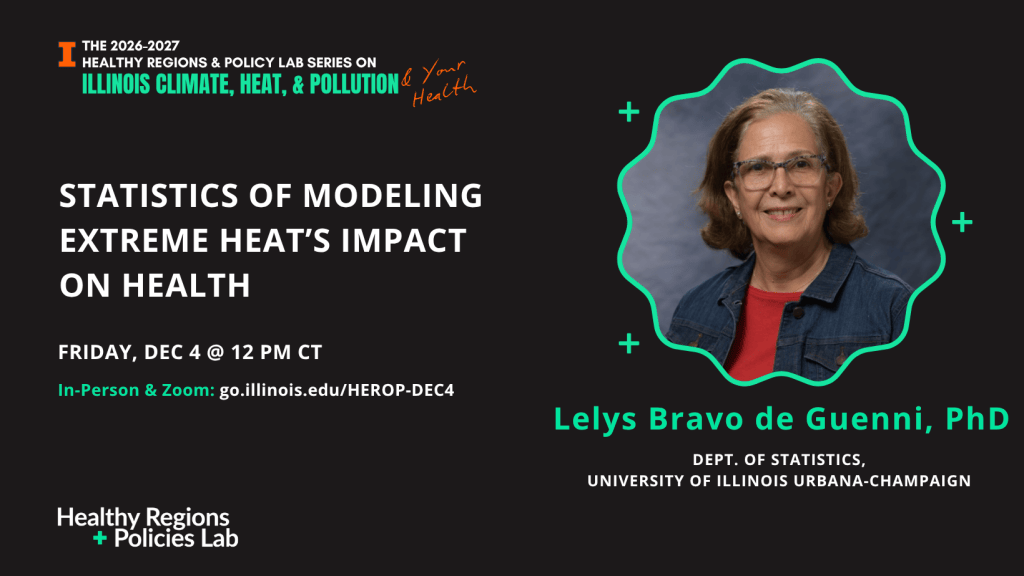
Join us for lunch, learning, and conversation at the next installment of the HEROP Speaker Series on Dec. 4th at 12 PM CT. Coffee & Networking session to follow. For folks outside of the UIUC community, please join us via Zoom!
The Statistics of Modeling Extreme Heat’s Impact on Health
Lelys Bravo de Guenni, PhD
Dept. of Statistics, University of Illinois Urbana-Champaign
Friday, Dec 4th @ Noon, via Zoom
& In-Person in Urbana, IL
Extreme heat is one of the most significant and rapidly growing climate-related threats to public health. Rising temperatures and more frequent heatwaves have been associated with increased mortality, emergency department visits, hospitalizations, and other adverse health outcomes. As communities seek effective strategies to mitigate these risks, robust statistical models are essential for quantifying heat-health relationships and informing evidence-based interventions.
This presentation reviews contemporary approaches used to assess the health impacts of extreme heat and highlights recent findings from our research on heat-related emergency department visits in the United States. Drawing from a systematic review of the literature, we compare commonly used methodologies, including distributed lag non-linear models, case-crossover designs, generalized additive models, and mixed-effects models. We discuss their strengths, limitations, and suitability for addressing challenges such as delayed health effects, regional heterogeneity, nonlinearity, and changing climate conditions.
The review identifies several persistent gaps, including inconsistent extreme heat definitions, limited incorporation of demographic and socioeconomic modifiers, limited real-time health data, and challenges linking climate projections with future health outcomes. We also present evidence that both ambient temperature and heat index are significant predictors of emergency department utilization, with substantial regional variation across the United States.
The findings underscore the importance of developing more transparent, reproducible, and policy-relevant modeling frameworks. Future advances should emphasize standardized exposure metrics, integration of climate projections and vulnerability factors, and real-time monitoring systems that support early warning and intervention efforts. Ultimately, improved heat-health models can strengthen climate resilience and guide public health preparedness in an increasingly warming world.
About the Speaker
Lelys Bravo de Guenni, PhD
Lelys Bravo de Guenni is a Clinical Associate Professor in the Department of Statistics at the University of Illinois Urbana-Champaign. She holds a PhD in Environmental Sciences from Griffith University in Brisbane, Australia, and has held visiting professorships at the University of California, Santa Cruz, Escuela Superior Politécnica del Litoral (Ecuador), and Northern Illinois University.
As an interdisciplinary environmental statistician, her research focuses on the spatial and temporal analysis of environmental data, with particular emphasis on developing quantitative methods for risk assessment under climate variability and change. Her work examines the impacts of extreme weather events and environmental hazards through statistical modeling, geospatial analysis, and predictive methods.
Her scholarship bridges statistics, environmental science, and climate risk assessment, advancing methodological approaches that support evidence-based decision making in environmental management and public policy. By integrating statistical innovation with real-world environmental challenges, her research aims to improve understanding of climate-related risks and strengthen resilience to future environmental change.
In-Person or Virtual?
The in-person RSVP option is open to the University of Illinois community (students, staff, and faculty). We will have lunch for all attendees who RSVP by Thursday @ 10 AM CT before the event.
A virtual option via Zoom is available for the public. The Zoom will open at 12 PM CT near the start of the talk. To register for the Zoom option, please access the following link: https://go.illinois.edu/HEROP-ZOOM-DEC4.
About the Series
The HEROP Speaker Series on Illinois Climate, Heat & Pollution connects scholars, experts, and innovative thinkers and highlights IL researchers and IL-based research on how a changing climate, extreme heat, and air pollution influence population health. Sharing how communities can make sense of the data to drive change locally with action-ready steps. The Healthy Regions & Policies (HEROP) Lab integrates innovative GIScience, public health, and statistical approaches to explore, understand, and promote healthy places. We’re experts in the spatial & social determinants of health. We’re based in the Dept. of Geography & GIScience at the University of Illinois at Urbana-Champaign.


Leave a Reply