Check out the HEROP’s lab latest article on understanding & advancing environmental justice (EJ) technologies and technospaces, published with open, free access at Wellbeing, Space & Society.
The article reviews EJ technologies from Pellow’s view of Environmental Inequality Formation, tracing perspectives across national, state, and regional applications like EJ Screen.
We include a survey of the state of EJ technologies in the United States, and show how the power and fragility of EJ technospaces were exemplified at the start of the second term of the Trump administration following the targeted removal of related governmental websites.
Research Highlights
- Environmental Justice (EJ) technologies may be further fortified and refined when connected directly with the communities impacted by environmental injustices.
- Grounding EJ technology work in explicit, equity-centered framings remains crucial to advance healthier communities by considering the content of data, how decisions were generated, as well as how resources will be distributed.
- When viewed as a technospace, the process of developing and engaging with GIS technologies present new opportunities for exploring, communicating, and contesting our understanding of environmental injustices, how environmental inequalities emerge, as well as serving to advocate for environmental justice.
- EJ technoscapes can no longer be conceived as passive products of the interaction of people and technology, but as active participants within EJ initiatives.
What’s a Technospace?
We bring back the term “technospace” to talk about the spatial-temporal, lived experience of engaging with a technological application. The technospace may influence individuals using the application, as well as the developers and application itself.
When viewed as a technospace, the process of developing and engaging with GIS technologies present new opportunities for exploring, communicating, and contesting our understanding of environmental injustices, learning how environmental inequalities emerge, and advocating for environmental justice.
We hope that these perspectives can revive more dynamic, experience-based perceptions of GIS development, moving towards more humanistic GIS conceptualizations and innovations.
Case Study: ChiVes @Chicago
We share a new approach to EJ application development as a case study in Chicago, connecting federated data across many stakeholders with nimble, low cost open source technologies and human-centered design.
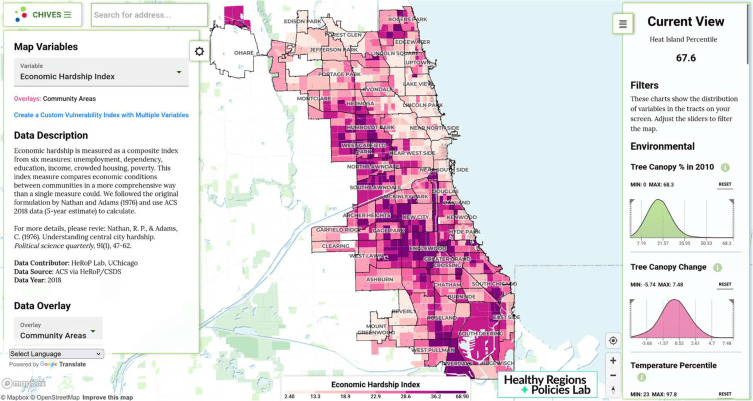
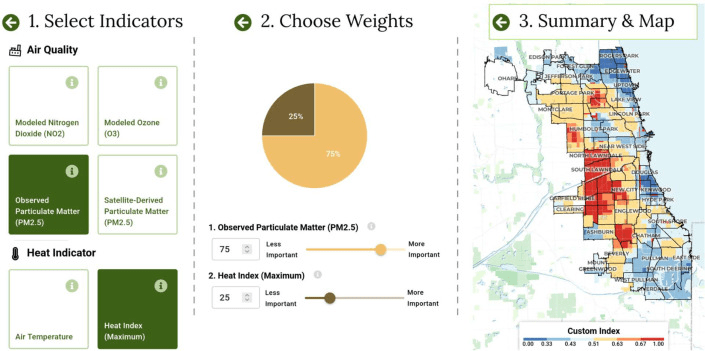
ChiVes is a data and mapping application linking dozens of tract-level social, health, and environmental indicators, serving as a decentralized, Open GIS focused on stakeholder relationships. Iterative development with community engagement enabled the ChiVes application to transform over time. Check out the article for more details, or head over to the web application to start exploring: chichives.com.
Research Team
The research team for this article incuded:
Marynia Kolak, Jack Lia, José Alavez, Shubham Kumar, Sara Lambert, Adam Cox, Susan Paykin, Winifred Curran, & Michelle Stuhlmacher.
Affiliations:
- Department of Geography & Geographic Information Science, University of Illinois, Urbana, IL
- National Center for Supercomputing Applications, University of Illinois, Urbana, IL
- Data Science Institute, University of Chicago, Chicago, IL
- Department of Geography and GIS, DePaul University, Chicago, IL
- Department of Geography, University of Washington, Seattle, WA
 Healthy Regions & Policies Lab
Leave a comment