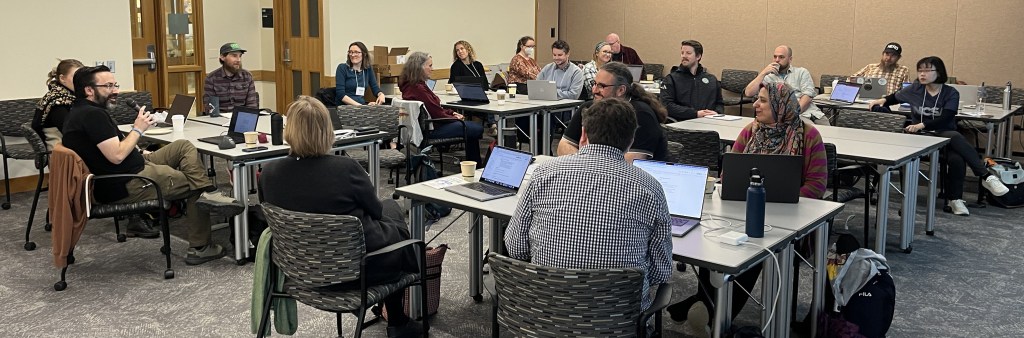
Healthy Regions & NCSA at Geo4Lib Camp 2025
In May 2025, Adam Cox and Pengyin Shan from the SDOH & Place Project team traveled to the University of Minnesota to attend Geo4Lib Camp, a small “unconference” for geospatial librarians and metadata experts from academic institutions across the U.S. Collaborating with members of this group since we started building the Data Discovery application has greatly shaped the trajectory of the project, so we were eager to share our work back with the community!
What is an “unconference”?
Typically, an academic conference will have a set schedule of paper presentations, a keynote, etc. An “unconference” does away with the scheduling, and instead, attendees propose and decide on discussion topics throughout the event. Geo4Lib Camp is a combination of both. Morning sessions were scheduled with presentations, panels, and a keynote. Afternoon sessions are “unconferenced,” filled with proposals and discussions based on topics of attendees’ interests.
The trip also served as an example of HeRoP’s collaboration with the National Center for Supercomputing Applications (NCSA), where Pengyin and her colleague Sara Lambert work. The HeRoP lab has established a solid partnership with NCSA since early 2024, with joint development of projects including SDOH & Place Project, ChiVes, and other geospatial projects. The travel to Geo4Lib Camp and co-presentation of the SDOH data discovery platform reflected a strong partnership and a shared commitment between HeRoP and NCSA to advancing geospatial discovery for public health research.

Why Geo4Lib Camp?
The infrastructure of our Data Discovery application was inspired by the software GeoBlacklight, an open source application for geospatial data discovery. Since its beginning in 2016, Geo4Lib Camp has largely been centered around the development and implementation of GeoBlacklight, and as our work evolved in parallel, it was natural for us to become involved with the community. Last year, Adam attended Geo4Lib Camp 2024 to present about Using Aardvark to Drive Public Health Data Discovery and with the recent “soft launch” of the Data Discovery platform and early-stage exploration of LLM-based document search, we considered the opportunity to present the continued evolution of the SDOH & Place project a meaningful extension of our continued involvement.
Talk about the Highlights!
We were lucky to have multiple opportunities to share our work through the course of the week, starting on the first day with our presentation: Highlights of the SDOH & Place Data Discovery Application (link leads to slides, no videos were recorded this year). While Adam began with an overview of the project architecture, Pengyin finished with a deep dive into how she has led the incorporation of LLM tooling directly into the middle of the search process. Both topics resonated strongly with the broader conversations throughout the week, offering timely contributions to ongoing dialogues around geospatial data discovery.

Instead of using GeoBlacklight out-of-the-box, our current Data Discovery app architecture embeds a new custom search interface directly into our existing website (https://sdohplace.org/search), while still using the same indexing software (Solr) and metadata schema (OGM Aardvark) as GeoBlacklight does. We have also built out an independent metadata manager to write records directly to the Solr index, and we were pleased to find that we are not alone in pursuing this kind of modular approach. Eric Larsen, lead developer of the Big Ten Academic Alliance (BTAA) Geoportal, presented about a similar model that they are exploring–a central API feeding lightweight, decoupled discovery interfaces–which could replace GeoBlacklight as the foundation of the BTAA geoportal in the future.
Lead the Discussion: Future of Search with LLM
A highlight of our work was the creation of an “AI search mode” for the Data Discovery application, which allows users to pose natural language questions like “What impact does housing stability have on the health outcomes of low-income populations?“. Our approach leverages the LLM API to interpret user questions and intelligently translate them into structured Solr queries. These queries are executed directly through our search engine, bridging natural language input with metadata-driven discovery while preserving a fact-based, transparent search experience. (Read more about this in Pengyin’s blog post: Transforming SDOH Data Discovery with LLM: A Different Journey.)
With growing interest in a deeper exploration of the topic, we also led an unconference discussion session later in the week, where we facilitated dialogue around the various factors and considerations for integrating LLM reasoning and generative AI into the search workflows. Key points from this session were:
- LLMs are generally effective at translating natural language questions into structured queries, but may face challenges when handling domain-specific or highly specialized inquiries.
- Even when asked to explain their reasoning, LLMs have been shown to “lie” by convincingly rationalizing their hallucinated answers
- LLMs could suggest workflows for how to use datasets that are returned by a query, even code snippets
Hearing different perspectives on the responsible utilization of LLM in data discovery helped us better understand the challenges and develop more trustworthy features for researchers and SDOH newcomers to engage with data more confidently.
It wasn’t all work…
Besides formal sessions, we enjoyed non-tech activities in the conference, like Surley Brewery for a group dinner, and a field trip to Eastview Geospatial‘s map distribution warehouse (they distribute all of National Geographic’s maps!).

Pengyin joined the tour of the Anderson Library’s subterranean caverns that house the university’s archives and special collections, as well as 1.4 million books, organized by size!
Overall, we were very fortunate to attend Geo4Lib 2025. We made new friends and connections, and received good feedback on our Data Discovery application. A big thanks to Shubham for the app design (people had great things to say about it!) and to the entire SDOH & Place Project team. We’re excited to keep building this momentum and continue our efforts on developing tools to enhance the research experience in SDOH studies.
 Healthy Regions & Policies Lab
Leave a comment