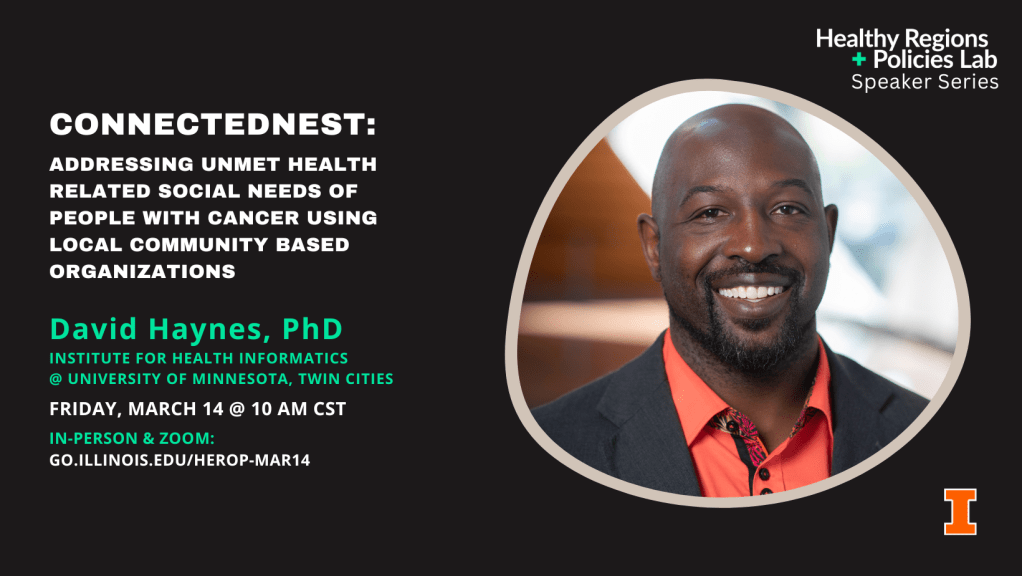
ConnectedNest: Addressing Unmet Health Related Social Needs of People with Cancer Using Local Community Based Organizations.
Join us for brunch, learning, and conversation at the next installment of the HEROP Speaker Series on Friday, March 14th, at 10 AM CDT. Brunch will be served from 10-10:10am, so please join us in person a bit early to eat & mingle!
David Haynes, PhD,
Institute for Health Informatics at the University of Minnesota, Twin Cities
Friday, March 14th @ 10AM,
via Zoom & In-Person in NHB 2049, Urbana, IL
Over 8 million people experiencing cancer face Health Related Social Needs (HRSN) challenges such as food, housing, and financial insecurity that directly impact their health outcomes. While individuals have unmet social needs, it is not well understood if they are willing to self-screen and connect to services independently. Therefore, we conducted a mixed-methods study in which we pilot-tested a patient-centered oncology-focused digital social care referral platform, ConnectedNest. We also adopted a community-based participatory approach for engaging with cancer-focused community organizations to understand their role and interest in this platform.
The results of this study demonstrate that participants will utilize an app to connect to community based organizations (CBOs) for unmet social needs and that ConnectedNest can facilitate connections and community resources. A community-based participatory approach highlights the importance of aligning and integrating CBOs’ values, needs, and operational challenges into ConnectedNest.
About the Speaker
David Haynes, PhD
Haynes is an assistant professor with the Institute for Health Informatics at the University of Minnesota, Twin Cities, with expertise in health information technology, health geography, and big spatial data. He has two focuses within my research on health and cancer disparities. The first focus applies spatial analysis methods to understand how lack of access to care perpetuates health disparities. His expertise in GIScience and geospatial computation is used to understand spatial-temporal patterns of population health. His work uses big data platforms to develop scalable workflows that analyze and communicate health data to broader communities. The second area of his research focuses on the development and implementation of health information technology to mitigate health disparities. This is a growing area of his research. He develops and implements health information technology to mitigate these disparities. He uses a community-based participatory approach in his design process to create technology that addresses community needs.
In-person or Virtual?
The in-person option is open the University of Illinois community (students, staff, and faculty). We will have brunch for all attendees who RSVP by Wednesday @10am before the event. To register for the in-person option, please access the following link: go.illinois.edu/HEROP-MAR14
A virtual option via Zoom is available for the public. To register for the Zoom option, please access the following link: go.illinois.edu/HEROP-ZOOM-MAR14
About the Series
The HEROP Speaker Series connects scholars, experts, and innovative thinkers to discuss different conceptual, methodological, and technological facets of public health to better understand the social determinants of health, and how place may influence outcomes. The Healthy Regions & Policies (HEROP) Lab integrates innovative GIScience, public health, and statistical approaches to explore, understand, and promote healthy places. We’re experts in the spatial & social determinants of health. We’re based out of the Dept of Geography & GIScience at the University of Illinois at Urbana-Champaign.
 Healthy Regions & Policies Lab
Leave a comment