
Building a Community Centered in SDOH & Place
The Social Determinants of Health (SDOH) & Place Project, led by the HEROP Lab and funded by the Robert Wood Johnson Foundation, works to build a community of practice around defining & using community-level social determinants of health. We developed a new toolkit to work with place-based SDOH data and develop mapping apps with free and/or open source software, and will soon launch a new search platform for discovering SDOH data. With a growing community of healthcare providers, neighborhood advocates, data scientists, geographers, and more, we’re also building community through discussions on defining SDOH and using SDOH data; engaging new types of collaborations and applications with design justice; and breaking ground in developing new types of infrastructures & tools to support this work.

The Summer Symposium
From June 14th to 15th in Chicago, the SDOH & Place Project Symposium showcased the incredible dedication and innovative approaches of the growing community in addressing social determinants of health and place-based inequities. Fifteen SDOH & Place Fellows showcased their web mapping applications centered in equity, while community and health leaders joined to share progress in moving the needle on health outcomes, SDOH, and Place — and how we talk about the data central to all these processes.
The symposium was an undeniable success, bringing together a community to share and celebrate groundbreaking research. It was an enriching experience, filled with fellowship and insightful presentations.
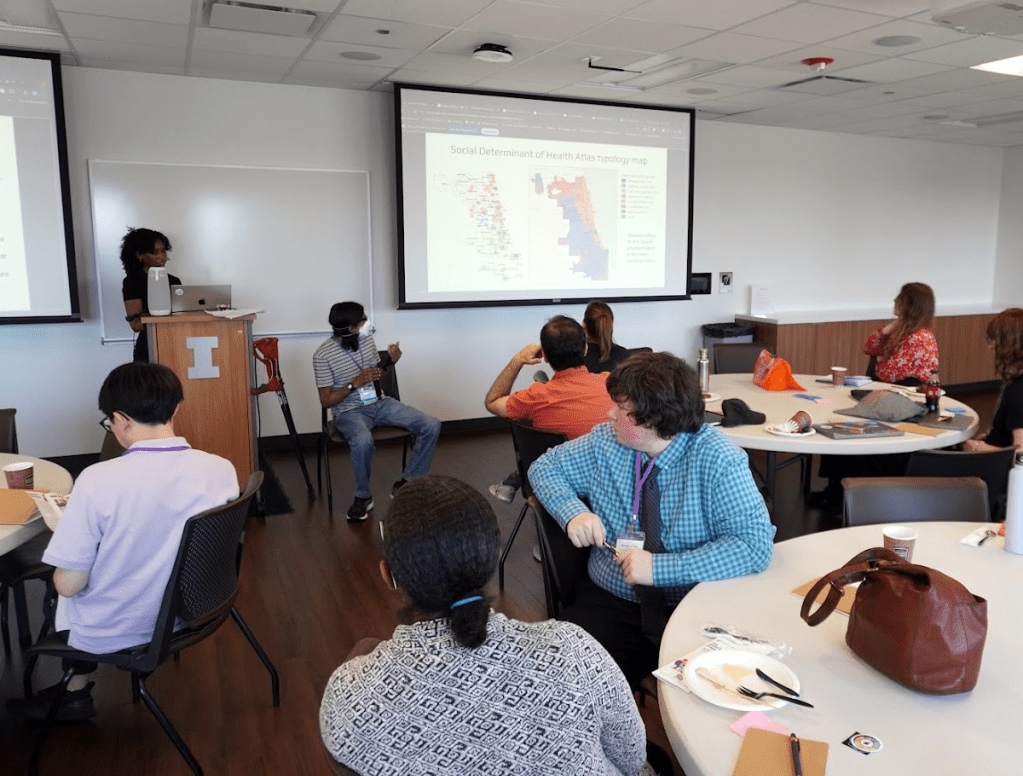
We are grateful to our Day 1 speakers for their contributions:
- Babu Gounder, University of Illinois, Urbana-Champaign: “Space, Place, and Food Justice: ‘Engaged GIS’ for Community Service Opportunities of Healthier Food Access in Areas Experiencing Social Inequities”
- Margarita Reina, City of Chicago: “Data Leadership Academy: Powerful Data-Driven Community-Centered Storytelling”
- Jacob M. Gizamba, University of Southern California: “Examining the Spatial Risk Environment of Bloodborne Infections – Viral Hepatitis and HIV”
- Aneika Perez, San Diego State/UC Santa Barbara: “Rethinking the Benefits and Potential Risks of Urban Agriculture in San Diego, CA: From Environmental Justice to Lead Contamination in Gardens”
We also enjoyed a PechaKucha/Lightning Blitz featuring:
- S M Asger Ali, Indiana University: SDOH, Health, and Wellbeing of Older Adults in Central Indiana
- Michael Lotspeich-Yadao, University of Illinois Urbana-Champaign: Using hierarchical cluster analysis to generate neighborhood definitions:
- The application of proportional flow matrices at the Census tract level
- Marynia Kolak, University of Illinois Urbana-Champaign: Measuring Access to Critical Resources for Opioid Use Disorder
- Xenia Miklin, Vienna University of Economics and Business: Spaces of Environmental Inequality: Mapping Intersections between Socioeconomic Disparities, the Environment and Policy in Austria

Day 2 focused on the keynote by Malaika Simmons, the talented SDOH & Place fellows, and highlights of Environmental Justice work happening in Pilsen, Chicago.
How might we … ?
Malaika Simmons
Malaika kicked off the day discussing “How Might We” improve health equity through Human-Centered Design. Malaika Simmons is the Chief Operating Officer for NADPH, a data-driven nonprofit health research organization. Through her organization, Momentology Media, LLC, she champions the elimination of economic and health disparities in underserved communities using her proprietary framework, The Momentology Method™, and promotes Human-Centered Design principles to provide thought leadership, motivational speaking, corporate training, and executive coaching.
Next, the fellows shared projects they worked on during the SDOH & Place Fellowship. The program’s virtual modules enhanced fellows’ skills to create impactful place-based visualizations using SDOH data, emphasizing human-centered design (HCD), equity, and participatory design principles for collaborative community applications. We will provide individual shoutouts for each fellow and their project soon, but here’s a glimpse of their impressive work.
- Beth Beyer The Technology Alliance: Hope, Education, Art (HEATChicago)
- Peter Chen University of Connecticut; Department of GIScience: Towards Inclusive GIS: Improving Food Access for a Low-Income Community in Northeastern CT
- Jessica Ann Davis University of Pittsburgh; School of Medicine: The 412 Breastfeeding Resource Map
- Tyler Gorham Nationwide Children’s Hospital: Mapping Policy, Inequity, and Opportunity in Linden, Ohio
- Amy Kryston Partners in Health: Montgomery, Alabama Asset Map
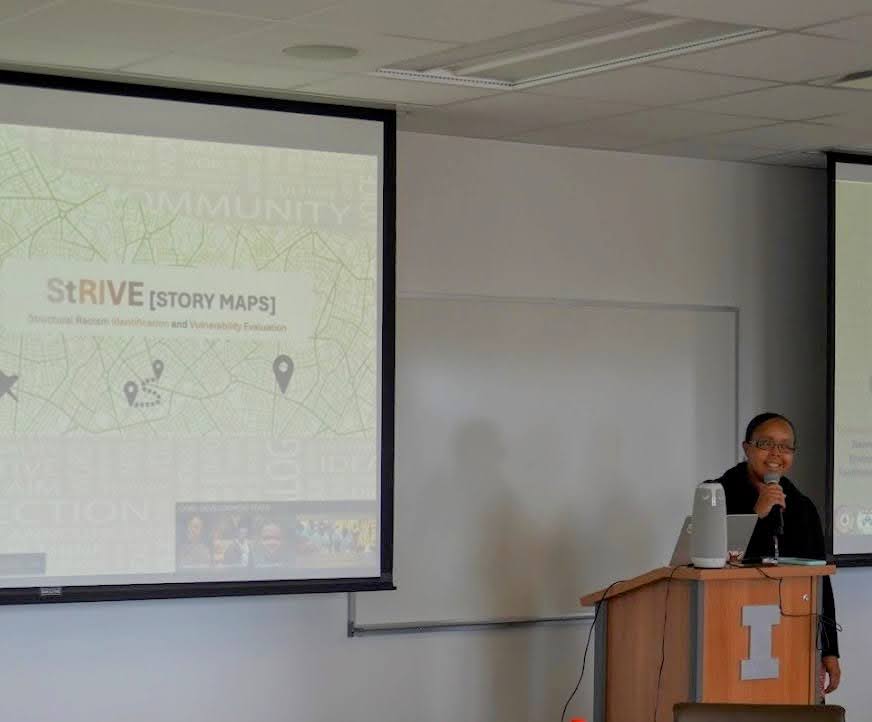
- Latrice Landry University of Pennsylvania; Department of Genetics: Structural Racism Identification and Vulnerability Evaluation (StRIVE) Story Maps
- Alexander Michels University of Illinois Urbana-Champaign: Spatial Accessibility with Machine-Learned Driving Times
- Sarah Nelson (with Nick Finn) University of Nebraska at Omaha; Department of Geography & Geology: A Strength-Based Mapping Project: Service Referrals for Indigenous People Seeking Help for Substance Abuse
- Kennedy Patterson University of Chicago; Department of Sociology: Mapping the Gendering and Racialization of Impoverished Deaths in Seattle, WA (2019-2023)
- Sonia Monet Saxon University of Illinois Chicago: Lived Experiences of Air Pollution in McKinley Park, Chicago
- Sarah Scott University of Pittsburgh: Allegheny County IPV Asset Map
- Madeline Smith-Johnson Rice University; Department of Sociology: Structural Inequality and Health by Gender and Sexuality
- Makiya Thomas Champaign Urbana Public Health District: The Champaign-Urbana Experience: The Motherhood Project
- Wei Tu Georgia Southern University; School of Earth, Environment, and Sustainability: Social Deprivation and Low Weight in Georgia
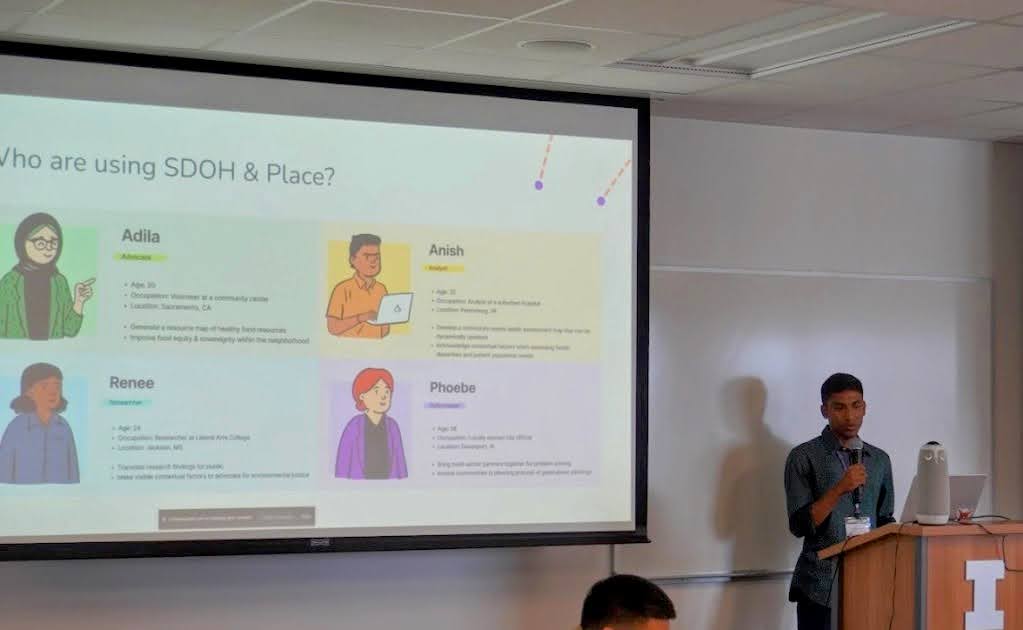
During our festive lunch time, the Healthy Regions and Policies Lab conducted an “Engineer & Designer Show-And-Tell” of the design process and updated progress for the SDOH & Place search discovery platform.
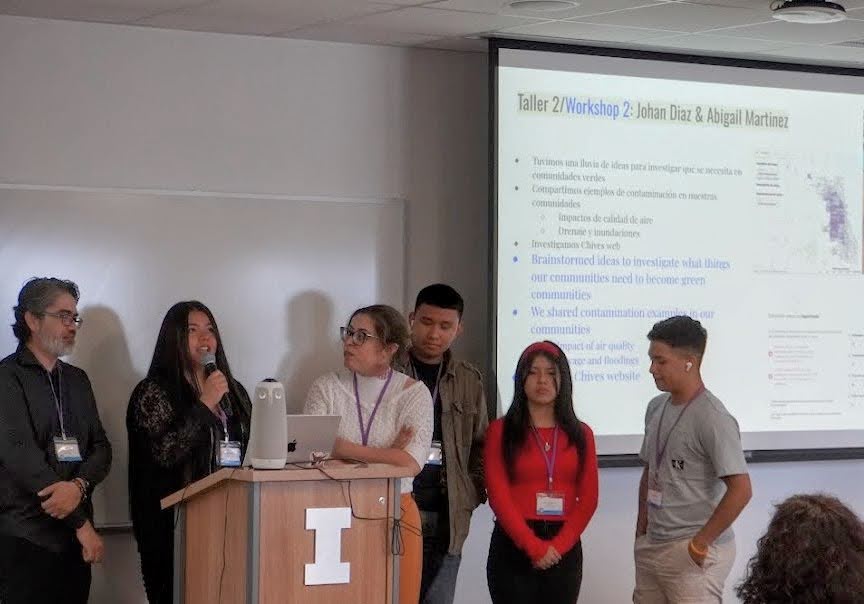
Lastly, Instituto Del Progreso Latino shared their work in advancing environmental justice as co-designers of Chives, a NASA-funded data collaborative and community mapping application that integrates environmental data at the neighborhood level in Chicago. Principal Maribel Arellano and Professor Arturo Galan led the discussion with students Norma Garcia, Johan Diaz, Abigail Matinez, and Heiker Garcia. Instituto is a nonprofit community agency offering legal services and application assistance to citizenship applicants, supporting the development of Latino immigrants and their families through education, training, and employment, promoting full participation in U.S. society while preserving cultural identity and dignity.
Dulce Garduño’s presentation followed, making a case for centering migrants in any discussions on SDOH & Place. Dulce, a Mexican immigrant and graphic designer, serves as the Pilsen Alliance treasurer, organized a tree-planting campaign, volunteers for the homeless, and hosts the radio show “Palabras de Vida” in Chicago. She is also a co-designer of Chives, and helped coordinate multiple environmental justice workshops to expand the application earlier this year.
We look forward to the continued impact of this important work and the inspiring contributions of our fellows and speakers. Thank you to everyone who participated and made this event a resounding success!
A little about our SDOH & Place Project Community Toolkit team
We are thrilled to introduce the dedicated team behind the SDOH & Place Project Community Toolkit. This toolkit is the result of collaborative efforts from a diverse group of experts committed to advancing health equity through innovative design and technology.
- Kamaria Barronville, Instructional Designer
- José Alavez, Postdoctoral Scholar
- Marynia Kolak, Principal Investigator
- Shubham Kumar, Product Designer
- Catherine Discenza, Graduate Research Assistant
- Marc Astacio-Palmer, Research Coordinator
- Adam Cox, Software Engineer
- Andre Vines, Illustrator
- Yilin Lyu, Graduate Research Assistant
- Mandela Gadri, PhD Student
Thank you to each member of our team for your hard work and dedication. Your contributions have been invaluable in creating a resource that will help communities use data to promote social and spatial equity. We look forward to seeing the positive impact this toolkit will have in driving meaningful change.
 Healthy Regions & Policies Lab